Showing posts with label History. Show all posts

Friday, November 03, 2006

Famous Generals: Part One


These were the brilliant military minds of the past. In the first of this series of posts on Famous Generals, I will begin with Hannibal Barca. A complete list of generals can be found here.
Hannibal originates from the Mediteranean (247 – 183 BC) and was one of the greatest military leaders and strategists of all time. Hi greatest enemy was Rome and its armies. He was so good, the Romans even adopted some of his strategies in their war-making. He hailed from Carthage, a city that was located on the eastern side of Lake Tunis across from the center of modern Tunis in Tunisia in Northern Africa. He is most well-known for invading Italy. He marched from Iberia over the Pyrenees and the Alps into northern Italy – all this with a contingent of war-elephants! He entered Gaul with 50,000 foot soldiers and 9,000 horsemen and by the time he was nearing Rome his army numbered 38,000 infantry, 8,000 cavalry, and thirty-seven war elephants. He defeated all on his way to Rome, including Capua, but was not strong enough for Rome itself.
All of this took about 10 years, during which the Romans regrouped and planned an attack on Northern Africa. This forced Hannibal back Carthage where he was defeated in the Battle of Zama. The Carthaginian Senate then subsequently forced him into exile. After About eight years in exile, the Romans demanded that he surrender himself, but he decided that suicide was a better way out.
In all he has been described as one of the most brilliant military minds ever and has induced fear in the hearts of the Romans for a while. Remember, all this happened before Julius Caesar, who only came into power round about 50BC. Hannibal’s wars were won not on numbers, but by battle-tactics. The armies he battled were mostly of larger numbers and had greatly respected generals who lead them. Even military geniuses like Napoleon Bonaparte referred to Hannibal in awe. Even long after his death, he would still be remembered in Rome and the rest of Italy as terrifying and people would exclaim “Hannibal is at the gate!” in situations of disaster. Also, when kids behave badly, mothers would say: “Behave well or Hannibal will come and get you!".

PS: I want to do a post on Famous Generals once a month. Please let me know if this bores you to death and I’ll change the subject!

Tuesday, October 03, 2006

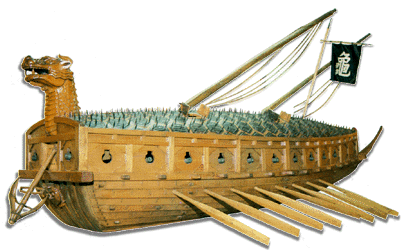
Turtle ships


I’m sure you’ve all seen the movie Sahara , based on the book by Clive Cussler. The plot in short: (quoted from IMDB )Master explorer Dirk Pitt goes on the adventure of a lifetime of seeking out a lost Civil War battleship known as the "Ship of Death" in the deserts of West Africa”. Now, this battleship is called an ironclad. Ironclads originated in Korea in the 1413. They were then called “turtle ships”. In those days it was basically a wooden hull covered with iron plates. They fitted these “turtle ships”, with up to 5 types of cannons, as it was 30 to 37 meters long. It also normally had some sort of a ramming tool mounted in front, probably a dragonhead. It was also fitted with oars and could hold about a hundred marines and about fifty oarsmen. It had 11 cannon-ports on each side, plus one fore and one aft. Its main purpose was to ram other ships, damaging them to such an extent as to drown them, while providing the necessary protection to those inside.

It looks like they were only used in river systems until 1859, when the French launched the first ocean-going ironclad called the La Gloire ("Glory"). Twenty-one months later, the British launched their version, called the HMS Warrior. In 1861, the first steam-powered ones were built for the American Civil War.

Subsequently, the Swedish, Spanish, Italian and many other European countries made us of these “river monitors”. Only drawback, while the ironclads were powerful, it was nearly impossible for the crew to escape if they were holed in deep water by a mine. The age of the ironclad came to an end in 1890, when they were replaced with pre-dreadnoughts.

All warfare is based on deception. Hence, when able to attack, we must seem unable; when using our forces, we must seem inactive; when we are near, we must make the enemy believe we are far away; when far away, we must make him believe we are near. Hold out baits to entice the enemy. Feign disorder, and crush him.
- Sun Tzu, the Art of War

Wednesday, September 20, 2006

When in Rome...


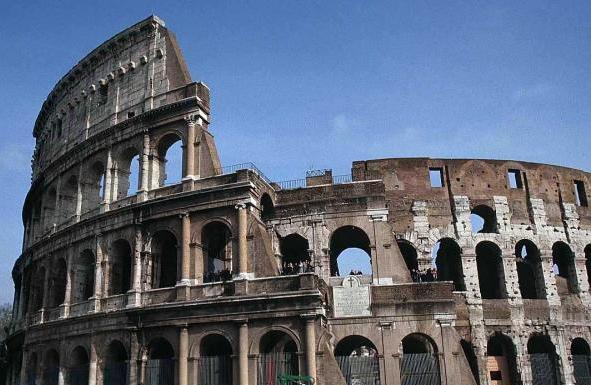
Now, I don’t know why, but I never really showed an interest in history or anything related when I was at school. But now I find the subject extremely interesting. Take ancient Rome for example. It all started with the TV series “Rome”. I started watching and wanted more information. The internet is a wonderful place! I found a wealth of information. One of the most interesting characters, was Gaius Julius Caesar. Caesar only became a title after he was in power. The naming convention is also most fascinating. For instance, they only had about 18 first names which they used. Caesar’s father was also Gaius Julius Caesar. The “Julius” refers to the clan he belonged to, the Julii. The last part “Caesar”, normally referred to a nickname or some sort of attribute of the person. It was often used in irony: Caesar means “hairy”, although he was balding! For the women, the names were just as weird. Sisters would often have the same name, the only way to discern would be the postfix of either “major” or minor”, depending on who was first born. For instance, Caesar had two sisters, both called Julia. One was Julia major and the other Julia minor. This obviously caused great confusion for historians, who often did not know who was referred to in ancient texts. Also, if the father’s name was Lucius, the daughter would normally be called Lucia.

Another thing I found interesting was Julius Caesar and Marcus Antonius’s (not Marc Antony as the series calls him) infatuation with the co-ruler of Egypt, Cleopatra. Caesar had a son (Caesarion) with her, and Marcus Antonius had three children with her, twins (boy and a girl) and a boy. Caesarion later became Ptolemy Caesar and ruled Egypt. Cleopatra was in fact not Egyptian, she was Greek. Her father was a lieutenant under Alexander the Great.

On my bedside table is the “"De Bello Gallico" and Other Commentaries by Julius Caesar”. What a fascinating read. It is all about Caesar’s conquest of Gaul (France) and describes many intricacies of Roman life at the time. I will post an update on this later when I’ve finished reading it. I’ll finish with this: many of Caesar’s quotes are famous, such as “Veni Vidi, Vici” (I came, I saw, I conquered), which he said after defeating Pompey. When he crossed the Rubicon river into Italy from Gaul, on his way to Rome to take care of Pompey, he said “Alea jacta est” (the die is cast), because he was not supposed to enter Italy with his legions, according to Roman law. One very famous quote by Marcus Antonius, “Friends, Romans, countrymen, lend me your ears” was apparently poetic licence by William Shakespear. He never said those words after Caesar’s assassination.

Lastly, on that note, Caesar was not just assassinated by Brutus, there were about sixty men involved. Brutus was merely one of them and Caesar asked "Tu quoque, Brute, fili mi" ("You also, brutus, my son?"). Therefore most people think its Brutus.

So, I leave you with the Latin : curate ut valeatis (take care that you fare well).